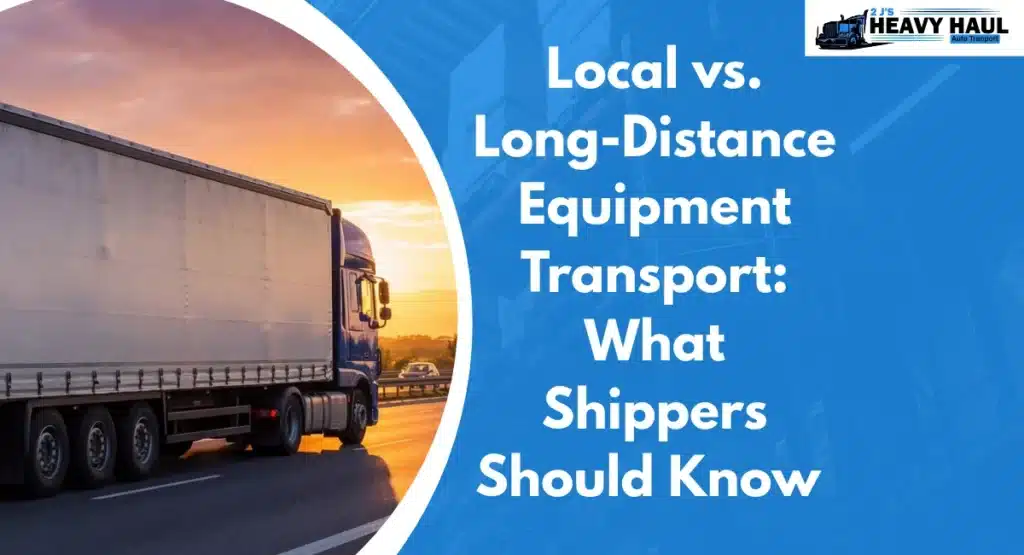
Moving an excavator across town and moving the same machine across five states are fundamentally different operations. The equipment might be identical, but the logistics, regulations, pricing structure, and timeline change significantly with distance. Understanding these differences helps you plan better, budget accurately, and avoid delays regardless of how far your equipment needs to travel.
Here’s what changes when your heavy equipment transportation goes from a local move to a cross-country haul.
What Counts as Local vs. Long Distance?
There’s no universal line, but the industry generally breaks it down like this:
- Local transport: Moves under 100 miles, typically within the same city, county, or metro area. Often completed within a single day.
- Regional transport: Moves between 100 and 500 miles, usually within the same state or into a neighboring state.
- Long-distance transport: Moves over 500 miles, crossing multiple states. These are the shipments where permitting, route planning, and logistics become significantly more complex.
The shift from local to long-distance isn’t just about miles. It’s about how many state lines, permit offices, regulatory systems, and logistical variables get added to the move.
How the Process Differs
Local Moves
Local equipment transport services are relatively straightforward. The carrier loads the equipment, drives it to the destination, and offloads it. That said, preparing your equipment before the truck arrives still applies regardless of distance. In many cases:
- No oversize or overweight permits are needed (if the load stays within the state’s legal limits on the roads being used)
- No pilot cars or escort vehicles are required
- Route planning is minimal, since the carrier knows local roads, bridge clearances, and traffic patterns
- The same crew handles loading, driving, and delivery
- Same-day or next-day pickup is common
The process is faster because fewer variables are in play. A local heavy equipment transport company familiar with the area can often dispatch a truck within hours.
Long-Distance Moves
Cross-country heavy equipment transportation services involve a much longer chain of coordination than a standard transport process:
- Multi-state permitting: Every state the route crosses requires its own oversize or overweight permit (if applicable), each with different fees, approved routes, and travel hour restrictions.
- Route engineering: The carrier maps the entire path around low bridges, weight-restricted roads, seasonal restrictions, and construction zones across multiple states.
- Escort coordination: Pilot car requirements vary by state. A load that needs one escort in Texas might need two in California. Each escort adds per-mile cost and scheduling complexity.
- Driver handoffs: On very long hauls, hours-of-service regulations may require driver changes or mandatory rest stops, which adds time to the transit window.
- Weather and road condition variables: The longer the route, the higher the chance of encountering weather delays, road closures, or detours that require rerouting.
Long-distance industrial equipment shipping is a managed project, not a simple pickup and delivery.
How Cost Structure Changes With Distance
Local Transport Pricing
Local moves are typically priced as flat rates or hourly rates rather than per-mile. That’s because the fixed costs of loading, dispatch, and carrier positioning make up a larger share of the total on short hauls.
Expect to pay:
- Flat rate: $500 to $4,000 for most local moves depending on equipment size and trailer type
- Hourly rate: $150 to $350 per hour for the truck and operator
Local moves don’t usually involve permit fees, escort costs, or fuel surcharges, which keeps the total lower even though the per-mile rate is technically higher.
Long-Distance Pricing
Long-distance moves are priced per mile, with rates that decrease as total distance increases because fixed costs are spread across more miles.
Typical per-mile ranges:
- 500 to 1,500 miles: $2.00 to $3.50 per mile
- Over 2,500 miles: $1.00 to $2.00 per mile
But the per-mile rate is only the base. On top of that, long-distance quotes include:
- Permit fees: $15 to $400 per state
- Pilot car costs: $1.50 to $3.50 per mile, per escort vehicle
- Fuel surcharges: Typically 15% to 20% of the base rate
- Detention fees: $50 to $200 per hour if loading or unloading runs over the scheduled window
A 2,000-mile move at $2.00 per mile looks like $4,000 in base freight, but after permits across 6 states, two escort vehicles, and fuel surcharges, the actual total can land between $8,000 and $15,000+.
How Timelines Compare
Local Moves
- Booking to pickup: Same day to 2 business days
- Transit time: A few hours to one full day
- Total turnaround: Often completed within 24 to 48 hours
If the equipment is within legal road limits, there are no permits to wait for and no multi-state coordination. The carrier dispatches when the truck is available.
Long-Distance Moves
- Booking to pickup: 5 to 14 business days (longer for super loads)
- Transit time: 3 to 10 days depending on distance and route restrictions
- Total turnaround: 1 to 3 weeks from first call to delivery
The timeline stretches because of permit processing. Some states approve permits in hours, while others take days or weeks. States with seasonal or time-of-day travel restrictions add further scheduling constraints. An experienced equipment hauling services provider builds all of this into the timeline upfront so there are no surprises mid-move.
When Does Distance Change the Equipment Needed?
For local moves, the carrier often uses whatever suitable trailer is available: a standard flatbed for legal-size loads, or a lowboy if the equipment is tall. The priority is speed and availability.
For long-distance moves, trailer selection becomes more calculated. The heavy equipment transport services provider evaluates how the trailer choice affects permit requirements across every state on the route. A machine that fits on a flatbed locally might need a lowboy for a cross-country move because a slightly lower deck height avoids oversize permits in three of the six states it crosses.
The trailer that saves the most on permits, escorts, and travel restrictions isn’t always the most obvious choice. That’s where the experience of a professional equipment transport service provider pays for itself.
Frequently Asked Questions
- Do local moves require oversize permits?
Only if the loaded trailer exceeds your state’s legal limits for width, height, length, or weight. If it stays within legal limits, no permits are needed regardless of distance. - Why do long-distance moves cost more than the per-mile rate suggests?
Permits, escort vehicles, fuel surcharges, and detention fees stack on top of the base rate. Each state on the route adds its own costs. - Can I get same-day pickup for long-distance heavy equipment transport?
Rarely. Long-distance moves need permit processing, route planning, and carrier scheduling that take 5 to 14 business days. Same-day pickup is realistic only for local moves. - Does the same company handle both local and long-distance equipment transport?
Yes. A full-service industrial equipment transport provider handles both, adjusting the level of permitting, routing, and coordination based on the distance involved.
Get a Quote for Any Distance
Whether your equipment is moving across town or across the country, 2 J’s Heavy Haul builds every quote around your exact load, your exact route, and your exact timeline. Local or long-distance, the same standard applies: transparent pricing, dedicated coordination, and safe, on-time delivery. 14+ years of heavy equipment hauling services experience across all 50 states.
Call (877) 325-7288 for a free, no-obligation quote, or request your quote online and get a response within hours.